
Spun Yarn

Spinning success sustainably
It was the year 1996, just after liberalisation, when Indian stood at the precipice of change. With a vision to manufacture the best quality synthetic yarn, the Kashi Vishwanath Textile Mill Private Limited (KVTMPL) was established. And just after 4 years, at the turn of the millennium, in the year 2000, this vision came to life as the premium quality polyester blended synthetic yarn production was started in dyed and grey, polyester, polyester-acrylic, and polyester-viscose are the major segments.
Soon, KVTMPL started manufacturing synthetic yarn with different kinds of blends in count ranging from 8s to 60s. It gave KVTMPL a staggering product range for customers to choose from!

KVTMPL is an ISO 9001-2015 company which owns and operates the brand name SPNG Group and is a well-known and deeply respected entity in the domestic and foreign yarn markets. The company manufactures yarn for suiting, shirting, knitting, stoles, pullovers, carpets, and a lot of other applications. Under the brand name SPNG Group , KVTMPL now shares the platform with various manufacturers and partners, creating the best-quality products across segments like multifold synthetic yarn, premium quality gray, and dyed synthetic weaving yarn.

KVTMPL also owns world-class, state-of-the-art machinery supplied by leading yarn equipment manufacturers like Schlafhrost (Germany), Leewha (Korea), Trutzschler (Germany), Stalam (Italy), Lakshmi Machine Works, Dalal Engg., Draft Air and several others, currently in use at the yarn spinning facility with a matching in-house dyeing plant.

Today, yarn is quintessential, not only to the fashion industry, but to the Indian economy itself. It accounts for over 11% of the total exports in India and is also responsible for providing large employment opportunities across categories and segments. Additionally, yarn is one of the cornerstones of Hon’ble Prime Minister Narendra Modi’s call for MAKE IN INDIA.

Generating employment

Spun Yarn Business Unit industry like fiber, technical Spun Yarn Business Unit, garment, geo Spun Yarn Business Unit, medical, etc., is the second largest, after agriculture, to provide employment to all type of workforce, whether skilled or unskilled. Apart from helping the environment and saving money, there are also economic benefits of recycling water bottles. In 2011, more than 2.3 million people worked in the recycling industry, a number that continues to grow. Though it is true that many industries create jobs, the recycling industry creates even more. It generates employment while helping the earth.

Product Range of Yarn

• 100 % Polyester grey dyed Yarn ( Virgin & Recycle)
• Melange Yarn ( Black & Colored)
• Blended dyed Yarn
• Slub yarn 100% Polyester & blended
• Count Range 8s-40s
• Autoconed single & multifold Yarn-waxed or unwaxed
• Vast Range of coloured Yarn as per customer’s requirement
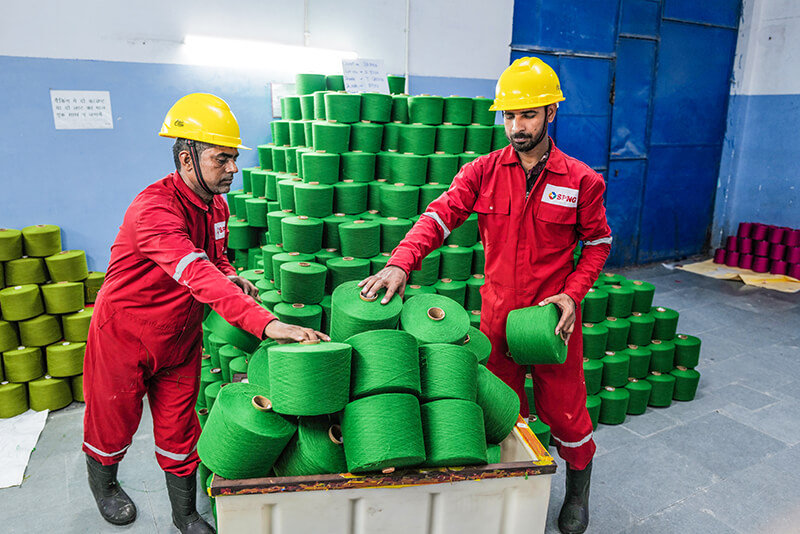
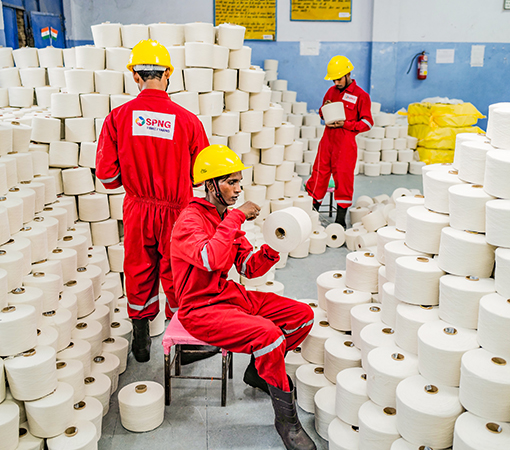
• Packing available in cone &jambo cone (in bags, carton, pallets)
• Twist available in normal & reverse
End Uses: Weaving, Knitting, Suiting, Hosiery, Stoles, Carpet< Fancy dress material etc.

The production process

This is a process that is divided into three stages. Here’s a closer look:
Stage 1
01. Pre-spinning

It comprises of many sub-stages of converting fibre into yarn. Though here actual yarn is not produced, it starts giving the shape of thread. It is where the raw material to be used in producing yarn, that is, fibre is opened, processed and mixed and laid, and is then passed through different machineries at different stages. The main sub-stages are:

Blow Room | Carding | Drawing | Speed Frame

Blow Room: This is the very first stage in the yarn manufacturing process also known as “Mixing” process. This is the stage where fibres are uniformly mixed and then are gently opened using blenders to be used in successive processes.

Carding: Blow Room is followed by Carding machine connected through where the remaining impurities are removed. Here, the opening and individualisation of fibres takes place. And bunch of fibre converts into thin, uniform “sliver”. The sliver is collected into the containers called cans.

Drawing: The Carding is followed by Draw Foam. Here, sliver foam card is fed and the fibres are made uniform and parallel. Quality of sliver produced by Draw Frame is much-much higher as compared to the sliver produced by Carding.

Speed Frame: This machine is also called Roving Frame or Inter Frame. This is the stage where Sliver produced by Draw Frame is processed and is converted into uniform and fine strand, and is wound on bobbin and the package is called Rovin Bobbin. This package is easy to handle and transport for the subsequent machine.

Stage 2
02. Spinning

The machine used is called Ring Frame. This is the process where actual yarn is manufactured. Here Roving, the output of pre spinning is used to manufacture yarn as per market requirements. Ring Frame or Spinning department is also called the heart of the yarn making process.
Stage 3
03. Post spinning

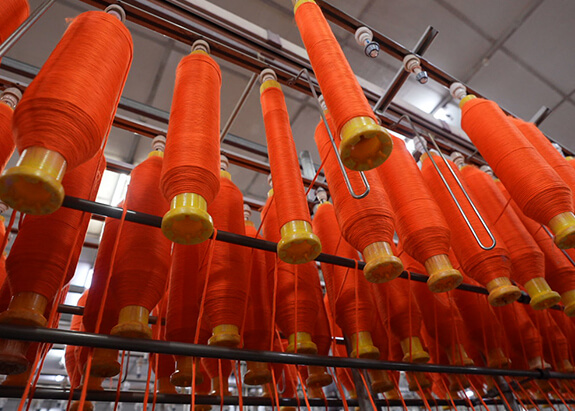
Here as per requirement, output of Ring Frame (actual yarn) is processed using many stages. This is basically based on number of plys to be twisted to cater to customer needs. Here the output of Ring Frame (Bobbins) is transformed into cones / hanks. Different machines used in this process are: 

Autoconer | TFO | Doubling | Cheese Winding | Winding | Yarn Conditioning